Employment regulations are one of those leadership responsibilities aviation directors know they cannot ignore. But knowing they matter is not the same as knowing where the real risks are.
A flight department can be highly disciplined about FAA compliance, safety, training, maintenance, and operational standards, but still have blind spots.
These can be around how employees are classified, how overtime is handled, whether a salaried role is truly exempt, or whether a job description still matches what someone actually does every day.
That is where employment law becomes more than an HR topic.
It affects compensation, retention, employee trust, legal exposure, and the way the company evaluates the professionalism of the flight department itself. It also forces aviation leaders to confront a reality many were never formally trained for: leading a flight department means understanding the business and people systems around the operation, not just the aircraft and the mission.
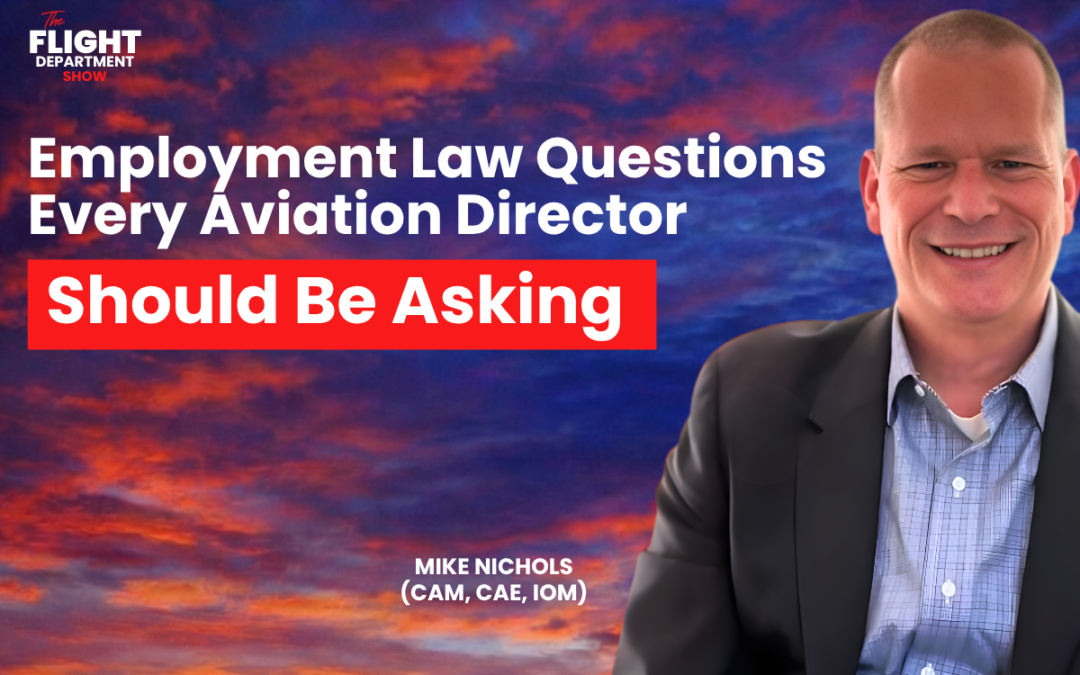
In this episode, Mike Nichols returns to unpack the employment regulations aviation leaders most need to understand, from FLSA and OSHA to age discrimination and retirement policies.
Employment law is not something aviation directors have to master alone, but they do have to engage with it. -Mike Nichols
What You’ll Discover in This Episode
- Why employment law belongs in the aviation director’s leadership toolkit, not buried in the background as a purely HR function
- The FLSA misconception that can create real risk: assuming a salaried aviation employee is automatically exempt from overtime
- Why job titles are not enough and how what someone actually does day to day can matter more than what their position is called
- The classification challenges that show up around pilots, maintenance professionals, schedulers, and dispatchers in Part 91 flight departments
- How irregular schedules, after-hours calls, holiday travel, and “availability to fly” complicate the way aviation work fits inside corporate HR systems
- Why OSHA still matters for small flight departments, including the misunderstood “rule of 10” and where FAA jurisdiction begins
- How mandatory retirement policies can become legally risky when aviation leaders apply airline assumptions to corporate flight departments
- Why the strongest move for aviation directors is not trying to know everything, but building the right relationship with HR, legal counsel, and internal business partners
About the Guest
Mike Nichols (CAM, CAE, IOM) is the founder of Flieger Strategies, a consulting company serving non-profit organizations, private/business aviation companies, and aircraft owners/operators. Flieger’s primary client is the Piper M-Class Owners & Pilots Association (PMOPA) and the PMOPA Safety & Education Foundation, where Mike serves as CEO. Nichols was a senior executive at the National Business Aviation Association (NBAA), where he worked for 18 years. During his tenure at NBAA, Nichols advocated for the business aviation industry on FAA rule-making committees, effectively preventing the implementation of onerous regulations while facilitating those that enhance safety and operations (among many other accomplishments). He is also an active instrument-rated private pilot and owns a Grumman Tiger aircraft. Connect with Mike on LinkedIn.
About Your Host
Dr. Chris Broyhill is the industry’s most respected authority on business aviation compensation. An industry veteran with over 43 years of aviation experience, Dr. Broyhill has led several scientific research projects on personnel retention, compensation, and leadership for the National Business Aviation Association (NBAA) since 2017.
Dr. Chris holds a Ph.D. in Aviation and has published two books that feature the results of his work. He’s also an outstanding graduate of the USAF Fighter Weapons School, an NBAA Certified Aviation Manager (CAM) Fellow, and a Certified Compensation Professional (CCP).
Resources
Get the Data, Win the Negotiation, Stay in the Business You Love. To get your compensation report, visit AirCompCalculator.com. We have a range of options for different scenarios and budgets, from validating a specific job offer, to packages for entire departments.